


- Lacquerware
- Kanagawa
Kamakurabori Kamakurabori
Heavenly carvings and unique patterns
from the engravings on Buddhist statues
Description
What is Kamakurabori ?
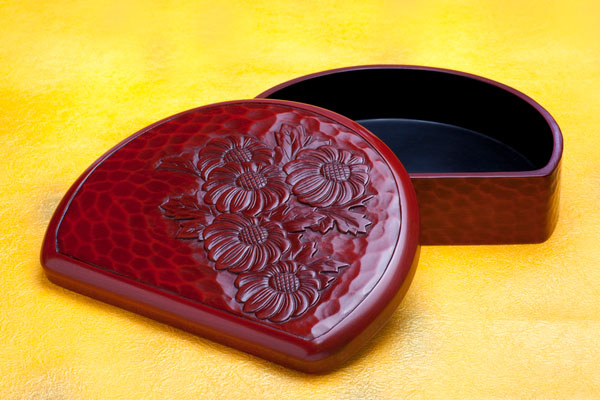
Kamakurabori is a type of lacquer ware made in the area around the city of Kamakura in Kanagawa prefecture. The tradition dates back to the Kamakura period (1185-1333) when Tsuishu and Tsuikoku, thickly lacquered wooden wares, were imported from China alongside other artistic crafts. The style of the imported wares was later incorporated with Japanese arts and traditional patterns and Kamakurabori was born. Initially, sculptors of Buddhist ritual implements and temple carpenters that were influenced by Chinese art works started to carve vessels made of Japanese Judas tree or ginkgo and applied a lacquer finish to the pieces, and these were called Kamakurabori. Today, production has spread to include everyday goods like inkstone cases, paperweights, plates, and trays. Kamakurabori features chisel markings left intentionally to accentuate patterned areas. Another unique technique is to sprinkle black ink on a vermilion lacquered surface, in order for the patterns to stand out from the darkened background. The carving and lacquering techniques of Kamakurabori have evolved for the past 800 years. Even today, Kamakura constantly attracts visitors looking for that perfect lacquer ware that will enhance daily life.
History
Kamakurabori has its origins during the Kamakura period among the sculptors of Buddhist ritual implements and temple carpenters. In the Muromachi period (1336-1573), Kamakurabori incense cases became popular in temples, and later, with the development of tea ceremony culture, Kamakurabori incense cases and tea boxes began to be used. During the Edo period (1603-1868), Kamakurabori spread beyond Buddhist ritual items, and daily goods began to be produced. Besides Chinese-style carvings, designs unique to Japan were gradually established.
At the beginning of the Meiji era (1868-1912), due to the passing of the Edict for Separation of Shinto and Buddhism by the Meiji government, an anti-Buddhist movement gathered momentum and led to a decline in the number of sculptors producing Buddhist items. Among the remaining sculptors, Itsuki GOTO and Kenzan MITSUHASHI were the two greatest who went on to develop the techniques of Buddhist sculpture and improve the quality of Kamakurabori crafts. Since then, Kamakurabori household items have gradually gained popularity among the general public, the techniques have continued to spread, and it is even used for interior design today. In 1979, Kamakurabori was designated as one of the Traditional Crafts by the Ministry of Economy, Trade and Industry.
Production Process
- 1. Choosing the timber
Kamakurabori is made out of Japanese Judas trees from Hokkaido. The timber is seasoned for six months to a year before being worked upon. Black ink is used to mark the basic shape which is cut with a band saw. Kamakurabori works are created collaboratively by many artisans each with a specialty skill, like carving, lacquering, and tool making.
- 2. Wood turning When making rounded products, including bowls, trays, and plates, the wood is turned on a lathe. Rounded products make up 70% of all production. The pieces are roughly turned and dried before being turned again to smoothen the shape. Other techniques include the combining of several boards and the hollowing and shaping of boards.
- 3. Painting
First a sketch is made, with patterns that conform to the shape and usage of the final item. These sketches are copied to traditional Japanese paper with aodake or green bamboo dye, before being traced onto the wood.
- 4. Rough engraving
The true beauty of Kamakurabori lies within the superb engravings. In the first engraving process, the traced lines are carved into the wooden base with a knife, the angle cuts are critical to bring out a sense of perspective and depth, and in this stage, artisans can freely show off their splendid skills.
- 5. Shading
The outer edges of the engraved lines are raised to make the patterns more prominent. This is highly skilled work because with one mistaken cut, the piece is ruined.
- 6. Chisel markings
With skillful use of a wide range of knives like a small one and a flat one, the carvings are fleshed out and improved. A feature of Kamakurabori is to intentionally leave chisel markings on the surface to accentuate the patterned area.
- 7. Undercoating
Raw urushi tree sap or raw Japanese lacquer is applied to the wood as an undercoat.
- 8. First coat
A first coat of raw Japanese lacquer is applied to the entire surface including engraved lines, followed by a sprinkle of carbon dust and polishing powder. This process maximizes the effect of the lacquer by accentuating the carved uneven surface.
- 9. Middle coat
Two coats of black urushi lacquer are applied and the artisan must pay special attention to prevent urushi pooling in the carved lines. When dried, the surface is polished with a whetstone and sandpaper.
- 10. Last coat
The last step is a final coat of scarlet pigment mixed with translucent Japanese lacquer.
- 11. Makomo powder sprinkling
Before the final coat has completely dried, a powder made from a plant called makomo is sprinkled on the surface. After drying, the surface is highly polished to give an antique appearance.
- 12. Raw Japanese lacquer As a finishing touch after polishing, raw Japanese lacquer is reapplied to the whole surface. After drying, more painstaking cloth polishing and polishing with susudama or baked clay powder is done to complete the Kamakurabori piece.
Representative Manufacturers
Kamakura-bori lacquerware Sansuido atelier
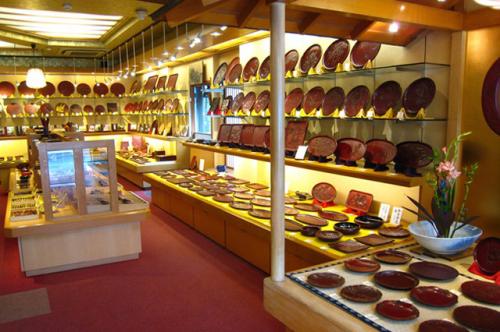
Sansuido atelier creates various exquisite traditional Kamakura-bori lacquerware products.
We take orders for any special occasions or presents and repair your lacquerware articles.
-
Founded1980
-
ClosedOpen all year long
-
DirectorGoro KOIZUMI
-
Business Hours9.30am to 6pm
-
Address
-
Website
-
Tel.+81-467-23-3999

Facility Information
Kamakurabori Craft Hall
-
Address
-
Tel.+81-467-23-0154
-
ClosedSundays, Mondays, holidays, around the New Year and about 1 week during spring and summer
-
Business HoursTue - Fri: 9:30am to 4:30pm / Sat.: 11am to 4pm
-
Website
Other Lacquerware
- Wajima Lacquerware
- Kamakurabori
- Tsugaru Lacquerware
- Aizu Lacquerware
- Yamanaka Lacquerware
- Kawatsura Lacquerware
- Echizen Lacquerware
- Joboji Lacquerware
- Kiso Lacquerware
- Hidehira Lacquerware
- Kagawa Lacquerware
- Ryukyu Lacquerware
- Takaoka Lacquerware
- Wakasa Lacquerware
- Hida Shunkei Lacquerware
- Ouchi Lacquerware
- Kanazawa Lacquerware
- Kishu Lacquerware
- Kyo Laquerware
- Odawara Lacquerware
- Naruko Lacquerware
- Niigata Lacquerware
- Murakami Carved Lacquerware