


- Dolls, kokeshi
- Tokyo
Edo Oshi-e Embossed Fabric Pictures Edo Oshie
The tradition of Edo that can be seen today
The Oshi-e techniques add style to the year-end markets
Description
What is Edo Oshi-e Embossed Fabric Pictures ?
Edo Oshi-e, or Edo Oshi-e Embossed Fabric Pictures, are a traditional craft produced around Nihombashi and Asakusa, Tokyo from the late Edo period (1603 - 1867). Today, they are also produced in Sumida ward, Koto ward, Katsushika ward in Tokyo, as well as in Saitama and Kanagawa.
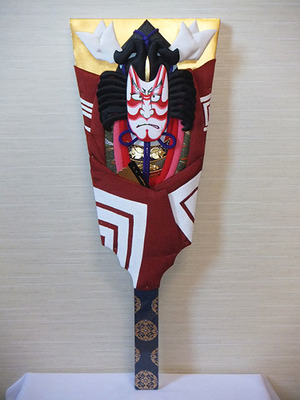
Oshi-e are made by glueing fabric onto a pasteboard or cardboard, then wrapping cotton with fabric to make embossed parts, and finally combining them to complete a three-dimensional picture. For Edo Oshi-e, features of the face are drawn on the embossed parts made of silk and cotton textiles, using the techniques for Japanese paintings to create an Ukiyo-e (a traditional Japanese painting mostly made by woodblock prints). Not only peoples' faces, but also scenery, animals and plants are created. When making an oshi-e of a kabuki actor, deep knowledge about kimono manners, combination of colors, and hairstyles is necessary.
Today, Edo-oshie is used for battledores, portraits, framed pictures, as well as decorations for folding screens and fans, and its beauty is enjoyed widely.
History
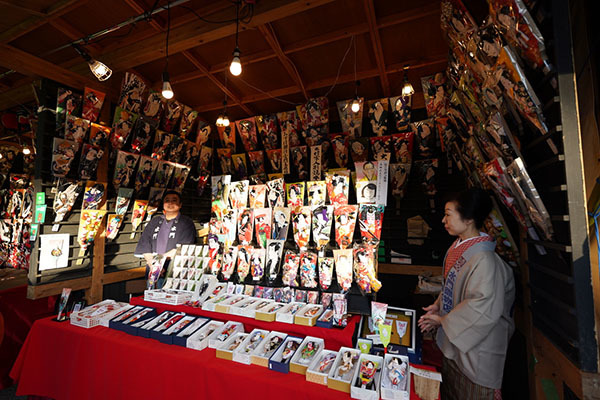
The Edo period was a time when the merchant class prospered, and reflecting this, the Edo Oshi-e developed. It became especially famous when it was used for decorating battledores.
Until then, patterns that were symbols of luck and happiness such as shichifukujin (the seven deities of good fortune> and pine, bamboo and plum trees were mainly used for batteldores. However, when kabuki became popular between 1688 - 1704, the pictures of kabuki actors were painted, and from 1804 -1830, batteldores of kabuki actors' portraits made with oshi-e were produced. With the popularity of kabuki and the progress in oshi-e techniques, the kabuki actor batteldores sold in huge numbers.
At the year-end, one could tell how popular a kabuki actor was by the number of battledores sold, and with these batttledores, Edo oshi-e became widely known to the public.
Production Process
- 1. Making paper patterns
A draft picture is drawn, and a paper pattern is made and cut out, taking the overlap width into account.
- 2. Cutting the cardboard
The pattern is traced onto the cardboard, which is to become the base, and the cardboard is cut.
- 3. Wrapping cotton
Cotton is placed on the cut out cardboard, and it is then wrapped with silk or cotton fabric.
- 4. Assembling
Japanese paper is applied to each part as a protection sheet, and the parts are assembled.
- 5. Coloring
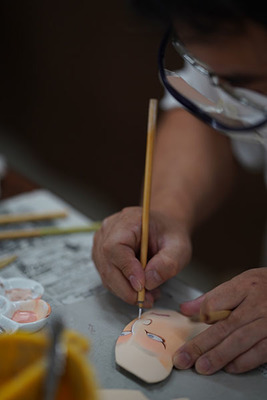
When drawing a face, the oshi-e is painted with a solution made of alum and glue, followed by whitewash to smoothen the surface, and is then colored with pigments.
- 6. Drawing
Glue, whitewash and pigments are mixed to paint the patterns of the kimono.
The method of making a batteldore and a framed picture are slightly different. The way cotton is inserted and how the oshi-e is assembled differs depending on what the final product is.
Other Dolls, kokeshi
- Hakata Dolls
- Iwatsuki Dolls
- Kyo Dolls
- Miyagi Kokeshi Dolls
- Edo Kimekomi Dolls
- Suruga Hina Dolls
- Edo Seasonal Festival Dolls
- Suruga Doll Accessories
- Edo Oshi-e Embossed Fabric Pictures
- Nagoya Festival Dolls and Decorations
Other Crafts Made in Tokyo
- Edo Kiriko Cut Glass
- Edo Wood Joinery
- Edo Glass
- Murayama Oshima Tsumugi Textiles
- Tokyo Silverwork
- Edo Patterned Paper
- Tokyo Fine Pattern Dyed Textiles
- Edo Bamboo Fishing Rods
- Tama Textiles
- Honba Kihachijo Fabric
- Edo Woodblock Prints
- Tokyo Yuzen Textiles
- Edo Seasonal Festival Dolls
- Edo Hyogu (Art Mountings)
- Edo Oshi-e Embossed Fabric Pictures
- Edo Tortoiseshell Crafts
- Tokyo Antimony Crafts
- Tokyo Hand-carved Seals
- Tokyo Honzome Chusen
- Tokyo Koto (Japanese Harp)
- Tokyo Plain Dyeing
- Tokyo Shamisen
