


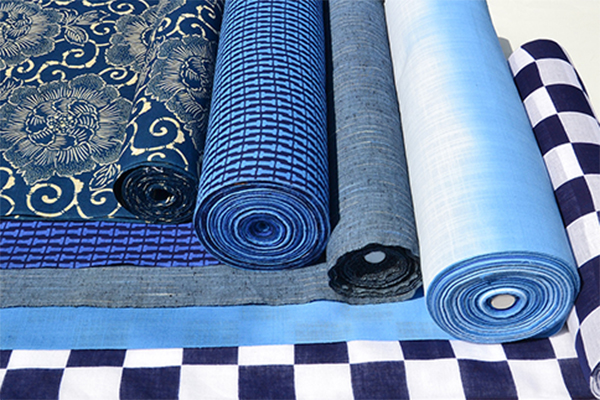
- Dyed textiles
- Tokyo
Tokyo Honzome Chusen Tokyo Honzome Chusen
An exquisite texture made from gradations and blurs
The skills of Edo to dye boths sides of the fabric beautifully
Description
What is Tokyo Honzome Chusen ?
Chusen is a dyeing technique to pour dye onto the fabric. By pouring dye onto layers of fabric from the top and bottom, both sides of the fabric are dyed beautifully so that there is no difference between the back side and front side. Fabrics dyed using this technique in the Kanto area are particularly called Tokyo Honzome Chusen.
Yukata (casual cotton kimonos) and tenugui (hand towels) are made using this technique, but the number of artisans and factories are decreasing. Chusen (dye pouring) is a technique unique to Japan. Using one stencil paper and dyeing in several colors by using resist glue is a dyeing technique that can only be seen in Japan. There is also a technique called bokashi zome where an experienced artisan uses two or more colors to create a gradation with exquisite balance.
As most of the processes are done by hand, no two pieces are the same. The unique textures made from delicate gradations and blurs that can only be made by an artisan's handwork is the charm of chusen.
History
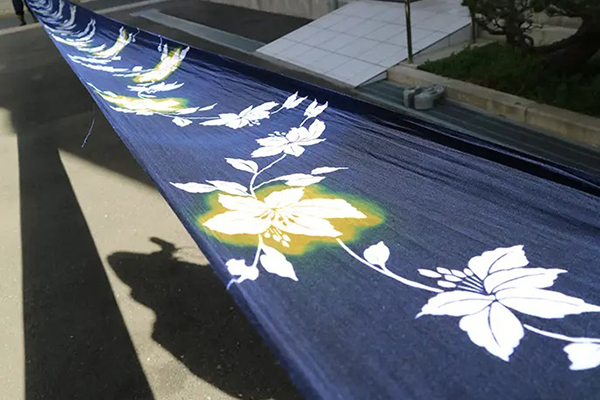
Chusen is a traditional technique with a history of more than 150 years. It became widely popular in the Meiji period as a replacement of nagaita chugata which was the mainstream dyeing technique up to then. Chusen was a revolutionary technique as fabrics dyed on both sides could be produced in large quantities by contriving ways to use resist glue.
Chusen is a technique used all over Japan, but Tokyo is the main production area. One of the reasons for this is because there used to be a custom in Edo (current Tokyo) where people gave tenugui as gifts, and as tenugui were used regularly in daily life, people in Tokyo were familiar with dyed products.
The number of factories and the demand for chusen which once flourished is decreasing with the change of life style and advent of chemical fiber. Even so, chusen is being used not only for tenugui and yukata, but also for clothes and bags that match the modern life style, and the traditional techniques of chusen are being passed down to the next generation.
Production Process
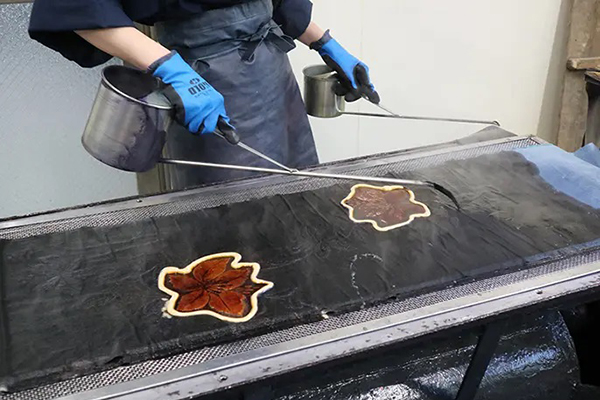
- 1. Softening the base fabric and drying The white base fabric is soaked in hot water to remove distortions to make dyeing easier and is dried in the sun.
- 2. Rolling up the fabric The fabric is straightened and made into rolls.
- 3. Preparing the glue and applying to the stencil paper Water and limestone powder is mixed into the resist glue made from glutinous rice. The stencil paper is stretched on the frame, the frame is placed on the fabric, and resist glue is applied with a spatula. The fabric is folded after the resist glue is applied and resist glue is applied on the next layer of fabric. This process is repeated.
- 4. Dyeing Dye is poured onto the surface with a kettle, and a compressor is used from the back side to draw the dye into the fabric . After one side is dyed, the fabric is turned over to dye the other side.
- 5. Washing and drying The resist glue and excess dye is washed away with water, and the fabric is dried in the sun.
- 6. Finishing After the fabric is dry, it is rolled up. Wrinkles are smoothed out using a roller, and the fabric is complete.
Representative Manufacturers
TOKYO WAZARASHI
-
Founded1889
-
ClosedSaturdays, Sundays, public holidays, summer holiday and year end and New Year holiday
-
DirectorIchiro Takizawa
-
Business Hours9:00-18:00
-
Address
-
Website
-
Tel.+81-3-3693-3334

Other Dyed textiles
- Kaga Textiles
- Kyo Yuzen Textiles
- Tokyo Fine Pattern Dyed Textiles
- Nagoya Yuzen Textiles
- Kyo Fine Pattern Dyed Textiles
- Arimatsu Narumi Tie-Dyeing
- Ryukyu Bingata Textiles
- Tokyo Yuzen Textiles
- Kyo Kanoko Tie-Dyeing
- Nagoya Black Montsuki Dyeing
- Kyo Black Montsuki Dyeing
- Naniwa Honzome Hand Dyeing
- Tokyo Honzome Chusen
- Tokyo Plain Dyeing
Other Crafts Made in Tokyo
- Edo Kiriko Cut Glass
- Edo Wood Joinery
- Edo Glass
- Murayama Oshima Tsumugi Textiles
- Tokyo Silverwork
- Edo Patterned Paper
- Tokyo Fine Pattern Dyed Textiles
- Edo Bamboo Fishing Rods
- Tama Textiles
- Honba Kihachijo Fabric
- Edo Woodblock Prints
- Tokyo Yuzen Textiles
- Edo Seasonal Festival Dolls
- Edo Hyogu (Art Mountings)
- Edo Oshi-e Embossed Fabric Pictures
- Edo Tortoiseshell Crafts
- Tokyo Antimony Crafts
- Tokyo Hand-carved Seals
- Tokyo Honzome Chusen
- Tokyo Koto (Japanese Harp)
- Tokyo Plain Dyeing
- Tokyo Shamisen