


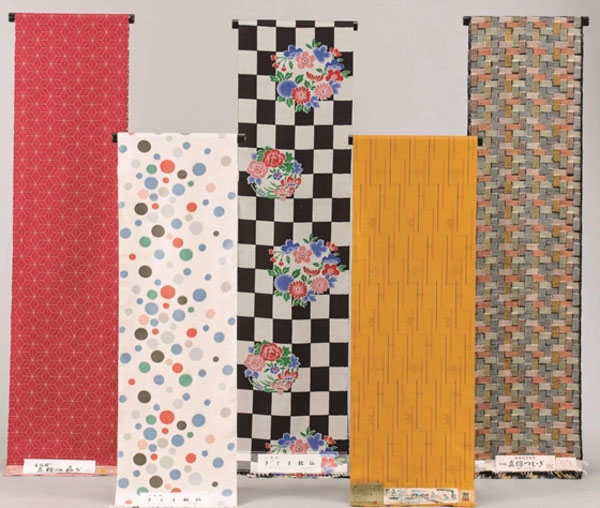
 Photo:Gunma Prefecture
- Woven textiles
- Gunma
Isesaki Gasuri Textiles Isesaki Gasuri
High skills and trust ties
form Gunma's famous textile
Description
What is Isesaki Gasuri Textiles ?
Isesaki Gasuri is a type of woven fabric produced in Isesaki, Gunma prefecture. Mainly used for kimono, this fabric has been admired for its texture since ancient times. Today, neckties and shop curtains called noren in Japanese are also produced. The more the fabric is used, the more the kasuri patterns* improve in appearance, as it gains richer shine and deepness in color. Isesaki Gasuri uses the following dyeing techniques: kukuri kasuri, itajime kasuri and katagami oshizomekako kasuri of which almost all of the processes are done by hand. The city of Isesaki has been successful in the sericulture industry for centuries as they had good soil drainage and the environment was suitable for growing mulberry trees. From an ancient burial mound in Fuchina, a piece of woven cloth estimated to have been created during the 6th century was found, proving that the history of the woven textile was more than 1200 years old. Also, it is recorded in the Nihon shoki or The Chronicles of Japan, which was completed in the year 720, that a textile called Ashiginu was presented to the Imperial Court. In Isesaki there is the Shidori Shrine, dedicated to the god of woven fabrics, and Akagi Shrine, dedicated to the ancestral weavers, showing how valued the weaving industry is to the city.
*A kasuri pattern, also known as ikat, is precise patterning that result from a technique of warp tying when dyeing.
History
During the early 18th century, cities bristled with silk markets which is where this textile started to be sold as a product. At these markets, designs like Isesaki shima and Isesaki futori were established as popular products. The increased demand for woven fabrics boosted the number of farmers who engaged in weaving, and growth accelerated with the establishment of motohataya, weaving shops that focused on the finishing process. After the development of a weaving technique regarded as the origin of Isesaki okasuri in 1847, this craft became even more beautiful through repeated improvements in the production process. During the late Meiji period (1868-1912), mechanization led to the golden age of production. After postwar reconstruction, Isesaki Gasuri revived production and was designated as a traditional craft in 1975. Today, an event called Isesaki Meisen Day is held every year in March, maintaining its recognition.
Production Process
- 1. Design
For Isesaki Gasuri, a design pattern is drawn on special plotting paper. This is something like a blueprint design where the quantity of threads and the finishing size is determined. The total number to be produced and the production procedures are confirmed at this stage. Each craftsmen has specialty designs that they are good at.
- 2. Preparation of threads
Raw silk threads are prepared for weaving by being boiled in a solution to remove impurities. This brings out the beauty of the raw silk. The refined silk threads are starched, and the preparation of threads is completed.
-
3. Reeling and warping
The starched silk threads are wound on a wooden frame to prepare them for the planned design. After making sure the tension of the threads are even, they are wound into balls.
- 4. Preparation for dyeing
This process, called sumitsuke, prepares the wound silk for dyeing. Using a plotting paper where the design is drawn, marks are drawn on the threads for dyeing. A frame with the same width as the finished silk is used when marking the threads.
- 5. Dyeing the threads
Surikomi nassen is thoroughly dyeing the threads by placing them between two bamboo spatulas and rubbing dye into them according to the marks. This process must be done with proficient craftsmanship.
- 6. Tying
The threads that are not part of the design are prepared to be dyed. After the parts that were dyed in the prior process have dried, special tape is applied to cover those parts to avoid the dyed design from mixing with the base color. The tying process being done by a kukuri kasuri artisan and their entire family was a common sight in this region. The first six steps are done by kukuri kasuri artisans, and the remaining are done by kasuri zome artisans.
- 7. Dip dyeing
The threads are immersed in hot water so that the color of the design pattern permeates and stays. After this, the base color is dyed by dipping the threads in boiling dye. The dye is gently stirred for an hour and the same temperature is maintained so that the dye turns out even. The dyed threads are then washed to remove impurities, dehydrated and starched.
- 8. Sizing alignment
The tape that was applied earlier is removed and the threads are dried in the sun. They are dried while the kasuri patterns are aligned.
- 9. Width adjustment
The width of the fabric is tailored to the size of the design drawn in step one. The threads are set up on the frame and aligned with a special tool.
- 10. Drawing threads
The threads are set on the loom and drawn through specific spots.
- 11. Weaving
The raw silk threads are woven into a fabric. This is an important process as the weaver must be very skilled for an excellent final result.
- 12. Final adjustments
As the fabric has been woven with starched threads, the starch is removed from the fabric at this stage. Then the fabric is steamed and straightened to its final size.
- 13. Inspection
The final product is checked for the correct width and length in accordance with the initial design. Isesaki Gasuri undergoes several steps, which are done by different expert traditional craftsmen in dyeing, weaving, and finishing work.
Facility Information
Isesaki Textile Center
-
Address
-
Tel.+81-270-25-2700
-
ClosedSaturday, Sundays, national holidays *Reservation required
-
Business Hours8:30am to 5pm
Other Woven textiles
- Nishijin Textiles
- Yuki Tsumugi Textiles
- Kurume Kasuri Textiles
- Ojiya Chijimi Textiles
- Hakata Textiles
- Ushikubi Tsumugi Textiles
- Chichibu Meisen Textiles
- Miyako Ramie Textiles
- Shiozawa Tsumugi Textiles
- Kumejima Tsumugi Textiles
- Omi Ramie Textiles
- Ryukyu Kasuri Textiles
- Kiryu Textiles
- Murayama Oshima Tsumugi Textiles
- Yumihama Gasuri Textiles
- Chibana Hanaori Textiles
- Hon Shiozawa Silk
- Oitama Tsumugi Textiles
- Ojiya Tsumugi Textiles
- Yaeyama Obi Sash Textiles
- Yaeyama Ramie Textiles
- Honba Oshima Tsumugi Textiles
- Shinshu Tsumugi Textiles
- Shuri Textiles
- Tama Textiles
- Yuntanza Hanaui Textiles
- Isesaki Gasuri Textiles
- Honba Kihachijo Fabric
- Nibutani Attus Bark Fabric
- Uetsu Shinafu Bark Fabric
- Awa Indigo Dyed Cotton Textiles
- Kijoka Banana Fiber Textiles
- Tokamachi Kasuri Textiles
- Tokamachi Akashi Chijimi Textiles
- Yonaguni Textiles
- Yuntanza Obi Sash Textiles
- Haebaru Flower Patterned Textiles
- Oku-Aizu Showa Karamushi Textiles
