


 Photo:Okinawa Prefecture
- Woven textiles
- Okinawa
Yuntanza Obi Sash Textiles Yuntanza Minsa
Brilliant colors of a tropical country
Beautiful geometric patterns
Description
What is Yuntanza Obi Sash Textiles ?
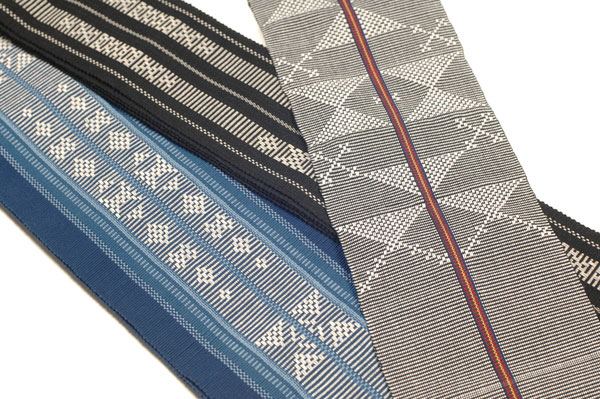
Yuntanza Minsa is a textile produced in the region around Yomitanson, Nakagami-gun, Okinawa prefecture. Min means "cotton" and sa means "narrow belt". Narrow belts were made in various regions in Okinawa from ancient times. Basically, Minsa is an indigo dyed narrow belt that is approximately 10cm wide, but the production techniques and the patterns vary depending on the region. Yuntanza Minsa is called Gushi Hanaori, a patterned textile made using the Gushibana technique; the weaver picks the warp threads using a bamboo skewer where the pattern should be raised. Yuntanza Minsa are a ribbed fabric woven with dyed cotton threads. They are made in brilliant, tropical colors and have embossed patterns created with the pattern stick or flower heddle. The patterns include floral patterns called gushibana and soko hana, as well as kasuri patterns made by tie-dyeing. These patterns and additional patterns such as stripes are woven. The dye used for Yuntanza Minsa is extracted from plants that grow naturally in the region such as Ryukyu ai (indigo), Fukugi (happiness tree) and Yeddo Hawthorn.
History
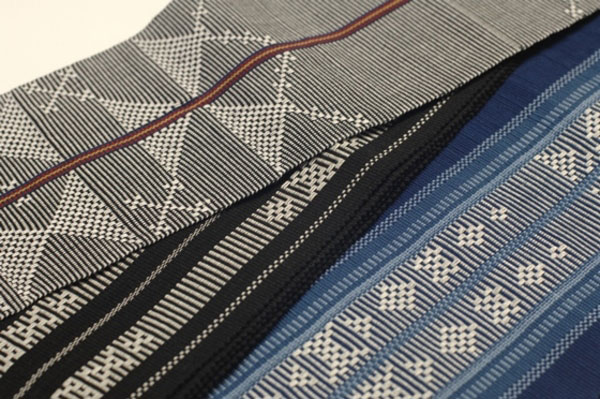 Photo:Okinawa Prefecture
It is assumed that Yuntanza Minsa was first produced around the same period as Yomitanzan Hanaori. Ryukyu was trading actively with China and southeastern Asian countries from ancient times. It is also assumed that the techniques to produce the kasuri patterns and the raised patterns used in Yuntanza Minsa, were brought back from China and southeastern Asian countries in the 15th century. The cultivation of cotton started in the region in 1611 when Shinjo GIMA brought cotton back from the Satsuma Domain. The area under cultivation was relatively small and the harvest was also small, so cotton was quite valuable. Women started to produce narrow belts for their families and loved ones, expressing their deep affection by making them, and this is said to be the origin of Yuntanza Minsa. However, the production of Yuntanza Minsa stopped for a while in the mid-Meiji period (1868 – 1912). In 1964, Sada YONAMINE, a dyeing and weaving artisan, and the local village people started a movement to revive Yuntanza Minsa and Yomitanzan Hanaori based on the stories from the village elders and the festival garments that survived the war. It took approximately ten years to revive these crafts.
Production Process
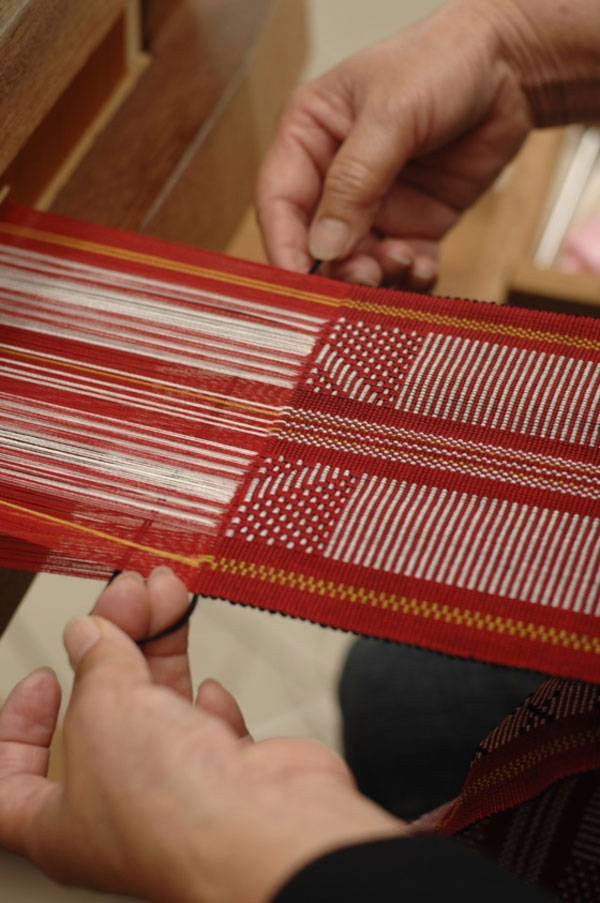 Photo:Okinawa Prefecture
- 1. Design The design is drawn on graph paper using colored pencils. Plants such as Jinbana (rhododendron), kajimayabana (pinwheel-shaped flower) and ojibana (fan-shaped flower) that naturally grow in Okinawa are used as the basic flower patterns for Yomitanzan Minsa. These basic patterns are arranged to make approximately 30 kinds of geometric patterns which are combined with kasuri patterns and striped patterns to make the design for Minsa.
- 2. Warp tying Yuntanza Minsa uses dyed cotton threads for the warp and weft threads. The kasuri threads are made by tie-dyeing by hand. The warp threads that become the kasuri threads are starched and pulled before being dried. Then, the parts to be left white are tied with cotton threads according to the design. Cotton threads are used because the fiber in cotton threads shrinks when they are wet, so the dye does not permeate inside. The threads are tied in widths of 8mm, 6mm and 1cm, with even spaces in between, and the threads are dyed. The dye is extracted from local plants including Fukugi (happiness tree), yeddo hawthorn, catbrier, Japanese chinquapin and Ryukyu indigo. The dyed threads are dried well and the tied cotton threads are removed. Cotton threads tend to stretch so the dyed threads are carefully sorted into equal lengths. The threads are starched and pulled to keep the kasuri patterns in their correct positions.
- 3. Winding the threads The dyed threads are wound into a skein before they are wound around a bobbin.
- 4. Warping The length and the width of Minsa are sorted in this process. The warp threads and the kasuri threads are sorted into the necessary number of threads and length that were calculated in accordance with the width of the Minsa. 320 warp threads are required for a width of 10cm.
- 5. Temporarily putting threads through reed The warped threads are put through the reed of the weaving width. The warp threads (ground threads and the kasuri threads) and the striped threads are put through the reed one by one, and the weaver checks the width of the textile. This reed is removed when the actual weaving starts, so this process is putting threads through the reed temporarily. The threads are put through the reed again after putting them through the heddle.
- 6. Winding the warp The warp threads that were put through the reed are wound while the tension in the threads is carefully adjusted. The tension in the threads is very important in this process so the strength to wind the threads should be even at all times. A beautiful Minsa can be woven by pulling he kasuri threads and ground threads evenly.
- 7. Putting threads through the heddle Yuntanza Minsa uses the Takahata loom. The warp threads that were wound in rolls are put on the loom and the reed is removed. The warp threads are divided into front and back threads and put though the eyes of the heddle one by one. The weft threads go through the space between the warp threads which is made as the heddle moves up and down. This is how the beautiful Yuntanza Minsa is woven. If the flower heddle is being used to weave flower patterns, the threads are set at this stage.
- 8. Putting threads through the reed After the threads have been put through the heddle, the threads are put through the reed again, one by one in the same manner as in the temporary process of putting the threads through the reed.
- 9. Weaving The gushibana technique is used for Yuntanza Minsa. The warp threads in the parts of the pattern that are to be raised are picked by hand using a bamboo skewer. By using this technique, the floral and striped patterns look as if they are raised from the surface when the textile is woven. This is one of the characteristics of Yuntanza Minsa. The hand-throwing shuttle is used for the weft threads and the flower heddle or a stick called monbo is used to weave the patterns. The woven Minsa is washed and pulled to neatly arrange the width. The production of Yuntanza Minsa is completed after the inspection.
Facility Information
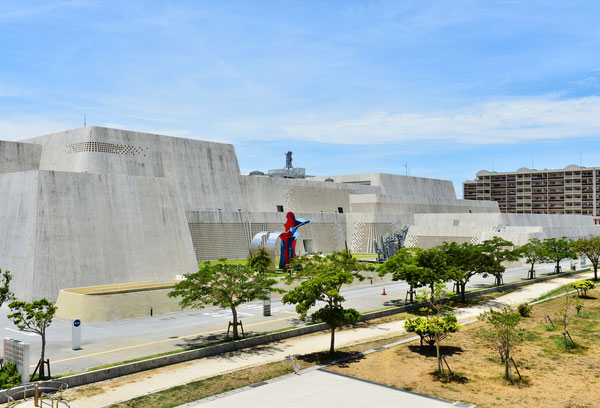
Okinawa Prefectural Museum & Art Museum
-
Address
-
Tel.+81-98-941-8200
-
ClosedMondays (open if Monday is holiday and closed the next day), December 29 to 31
-
Business Hours9am to 6pm Fridays & Saturdays 9am to 8pm
-
Website

Other Woven textiles
- Nishijin Textiles
- Yuki Tsumugi Textiles
- Kurume Kasuri Textiles
- Ojiya Chijimi Textiles
- Hakata Textiles
- Ushikubi Tsumugi Textiles
- Chichibu Meisen Textiles
- Miyako Ramie Textiles
- Shiozawa Tsumugi Textiles
- Kumejima Tsumugi Textiles
- Omi Ramie Textiles
- Ryukyu Kasuri Textiles
- Kiryu Textiles
- Murayama Oshima Tsumugi Textiles
- Yumihama Gasuri Textiles
- Chibana Hanaori Textiles
- Hon Shiozawa Silk
- Oitama Tsumugi Textiles
- Ojiya Tsumugi Textiles
- Yaeyama Obi Sash Textiles
- Yaeyama Ramie Textiles
- Honba Oshima Tsumugi Textiles
- Shinshu Tsumugi Textiles
- Shuri Textiles
- Tama Textiles
- Yuntanza Hanaui Textiles
- Isesaki Gasuri Textiles
- Honba Kihachijo Fabric
- Nibutani Attus Bark Fabric
- Uetsu Shinafu Bark Fabric
- Awa Indigo Dyed Cotton Textiles
- Kijoka Banana Fiber Textiles
- Tokamachi Kasuri Textiles
- Tokamachi Akashi Chijimi Textiles
- Yonaguni Textiles
- Yuntanza Obi Sash Textiles
- Haebaru Flower Patterned Textiles
- Oku-Aizu Showa Karamushi Textiles
Other Crafts Made in Okinawa
- Tsuboya Ware
- Miyako Ramie Textiles
- Ryukyu Lacquerware
- Kumejima Tsumugi Textiles
- Ryukyu Kasuri Textiles
- Chibana Hanaori Textiles
- Yaeyama Obi Sash Textiles
- Yaeyama Ramie Textiles
- Shuri Textiles
- Yuntanza Hanaui Textiles
- Ryukyu Bingata Textiles
- Kijoka Banana Fiber Textiles
- Yonaguni Textiles
- Yuntanza Obi Sash Textiles
- Haebaru Flower Patterned Textiles
- Sanshin